7 Leadership Beliefs To Retire
Apr 17, 2026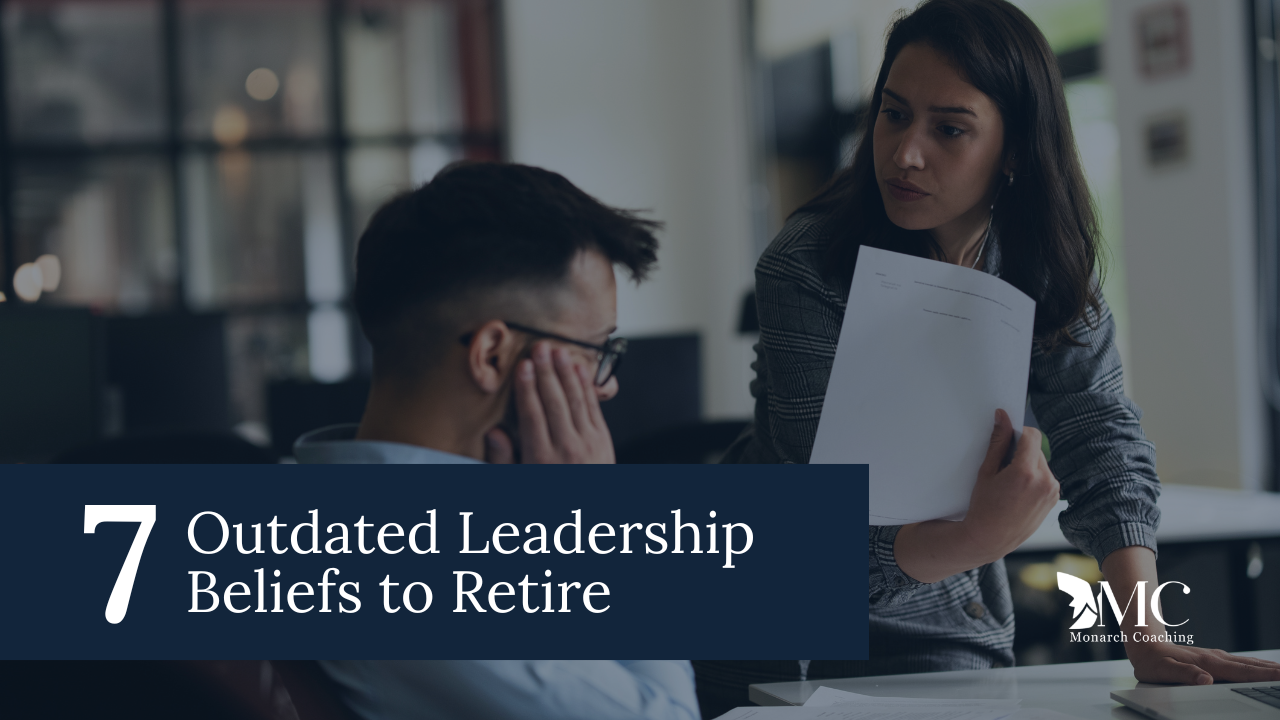
Why modern leaders must unlearn outdated habits to build trust, engagement, and performance
There was a time when leadership was defined by hierarchy, control, and certainty.
The leader was expected to have all the answers. Employees were expected to follow directions without question. Productivity was often prioritized over people, and vulnerability was mistaken for weakness.
But the workplace has changed. A lot.
Today’s most effective leaders understand that sustainable performance doesn’t come from authority alone. It comes from trust, adaptability, and human connection.
At Monarch Coaching, we help organizations challenge outdated leadership mindsets and replace them with behaviors that drive engagement, retention, and measurable performance outcomes.
Here are seven leadership beliefs that no longer serve today’s workforce, and what to embrace instead.
1) “Leaders must have all the answers”
The outdated belief that leaders must always be the smartest person in the room creates bottlenecks, fear, and dependence
Modern leadership is less about having answers and more about asking better questions.
Powerful leaders create space for dialogue:
- What are we missing?
- What does success look like from your perspective?
- What solution would you recommend?
When leaders co-create solutions with their teams, they build ownership, confidence, and stronger decision-making muscles across the organization.
Action step:
This week, replace one directive with a coaching question. Invite your team to problem-solve before you offer your perspective.
2) “Employees should just follow orders”
Compliance is not commitment.
People are far more engaged when they understand the why behind their work and feel empowered to contribute to the how.
Autonomy, ownership, and purpose are the real drivers of discretionary effort.
Employees don’t simply want tasks, they want meaning, trust, and the ability to influence outcomes.
Action step:
Audit one team process and ask: Where can we give employees more ownership or decision-making power?
3) “Leadership is about authority and control”
This belief especially breaks down in remote, hybrid, and cross-functional environments.
Today, leadership influence matters more than positional power.
Control may produce short-term compliance, but trust creates long-term commitment.
The strongest leaders know how to:
- Build credibility
- Communicate clearly
- Create psychological safety
- Collaborate across differences
- Influence without overpowering
Authority-based leadership can quickly become oppressive when it leaves no room for voice, challenge, or growth.
Action step:
Ask yourself: Do people follow my title, or do they trust my leadership?
Then identify one way to increase collaboration this week.
4) “Mistakes are failures to avoid”
Mistakes in process are often the birthplace of innovation.
When leaders create cultures where people are afraid to fail, they unintentionally shut down experimentation, learning, and creative thinking.
The real risk isn’t making mistakes in systems or workflows. It’s damaging trust in relationships.
Processes can be fixed. Broken trust takes much longer to repair.
Modern leaders treat mistakes as data:
- What did we learn?
- What needs to change?
- How do we improve the process moving forward?
Action step:
During your next team debrief, normalize learning by asking: What did this teach us? instead of Who caused this?
5) “Leaders shouldn’t show vulnerability”
This may be one of the most harmful outdated beliefs still present in leadership culture.
Authenticity builds trust.
When leaders appropriately share challenges, lessons learned, or stories of resilience, teams connect on a human level.
Vulnerable storytelling helps employees see possibility.
Statements like “I’ve been there before” or “Here’s what I learned from that experience” strengthen credibility and emotional connection.
Vulnerability is not oversharing, it’s intentional openness that helps others grow.
Action step:
Share one leadership lesson from your own journey during your next team meeting. Focus on what you learned and how it can support your team today.
6) “One-size-fits-all leadership works”
It doesn’t.
Modern leadership requires adaptability across communication styles, personalities, lived experiences, and generations.
The most effective leaders are what we often call leadership chameleons. Not inauthentic, but responsive.
They make thoughtful adjustments that help others succeed.
At Monarch Coaching, this adaptive leadership approach is core to how we teach managers to lead inclusively and effectively. Because often, it takes very little extra effort to lead with kindness, flexibility, and emotional intelligence.
Action step:
Identify one team member whose communication style differs from yours. Adjust how you communicate with them this week and observe the difference.
7) “Productivity matters more than people”
This mindset is costing organizations trust, retention, and performance.
Employee well-being is not separate from productivity, it fuels it.
Engaged employees create better customer experiences, stronger collaboration, and more sustainable business outcomes.
The truth is simple: happy employees often create happy customers.
Your employee experience is directly tied to your productivity metrics.
Action step:
Ask your team one question this week: What’s one thing that would make your work feel more sustainable right now?
The Bottom Line
The leadership beliefs that built yesterday’s workplaces will not sustain tomorrow’s.
The future belongs to leaders who ask powerful questions, lead with trust, adapt with empathy, prioritize well-being, normalize learning, & influence through connection.
That’s how organizations strengthen engagement, retention, and culture.
That’s how leadership becomes transformational.
Ready to help your leaders evolve?
At Monarch Coaching, we help organizations modernize leadership through practical development experiences rooted in emotional intelligence, inclusion, and measurable business outcomes.
Click Here to schedule a discovery call with Monarch Coaching to explore leadership training programs built for today’s workforce.
#LeadershipDevelopment #EmployeeEngagement #InclusiveLeadership #EmotionalIntelligence #WorkplaceCulture #PeopleLeadership #FutureOfWork #MonarchCoaching
